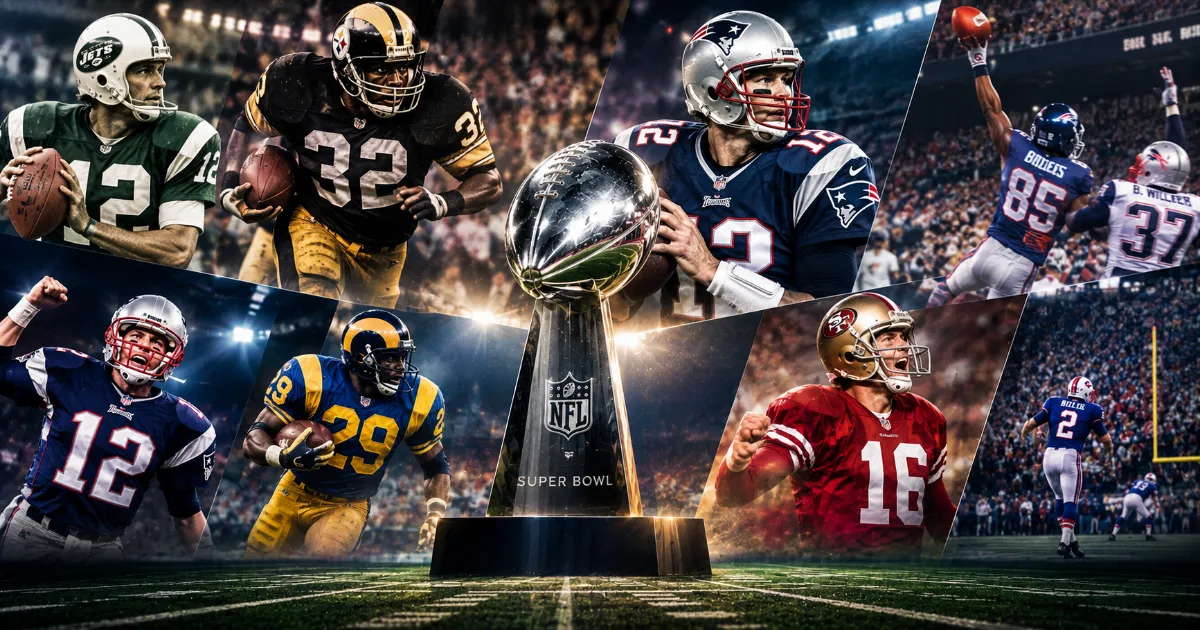
Using a simple scoring rubric built on stakes, drama, and legacy, here’s how the greatest Super Bowl games ever actually stack up against each other.
Not Every Championship Game Is a Classic
Sixty Super Bowls have been played, and the uncomfortable truth is that most of them weren’t particularly good football games. Blowouts outnumber classics by a wide margin, and even some of the most historically significant Super Bowls — title-clinching moments for legendary dynasties — were decided by the third quarter. Super Bowl LX in February 2026 is a recent example: Seattle’s 29-13 win over New England was historically meaningful, denying the Patriots a record seventh title, but by the game’s own broadcast coverage, it was “devoid of drama,” with the outcome rarely in doubt after halftime.
Super Bowl Winners List: Every Champion From Super Bowl I to LX
That’s exactly why the games that do earn a spot on this list deserve real scrutiny rather than just a nostalgic nod. To rank them fairly, each game below is scored across four categories — Stakes (what was on the line), Drama (how close or dramatic the finish was), Iconic Moment (a single play or sequence that defined the game), and Legacy Impact (how much the result shaped the sport afterward) — each worth up to 2.5 points, for a Drama Score out of 10.
Most Passing Yards in NFL History: Ranking the Top 10 Career Leaders
10. Super Bowl III — Jets 16, Colts 7 (1969)
Drama Score: 7.8/10
Joe Namath’s public guarantee that his heavily underdog Jets would beat the Baltimore Colts remains one of the boldest predictions in sports history — and he backed it up. This wasn’t a nail-biter in the modern sense, but its significance is impossible to overstate: it proved the upstart AFL could compete with the established NFL, directly paving the way for the eventual merger of the two leagues. The Colts entered as 18-point favorites, making the final margin one of the more stunning gaps between pre-game expectation and final result in the list’s entire history. Stakes: 2.5. Drama: 1.5. Iconic Moment: 2.0 (Namath’s guarantee itself became the moment). Legacy Impact: 1.8.
9. Super Bowl XIII — Steelers 35, Cowboys 31 (1979)
Drama Score: 8.0/10
Widely considered the greatest collection of talent ever assembled in a single Super Bowl — 18 future Hall of Famers between both rosters — this shootout saw Terry Bradshaw throw for 318 yards and four touchdowns against Roger Staubach’s Cowboys. Pittsburgh appeared to have the game salted away at 35-17 before Dallas mounted a furious, ultimately unsuccessful comeback attempt in the final minutes. Stakes: 2.3. Drama: 2.0. Iconic Moment: 1.8. Legacy Impact: 1.9.
8. Super Bowl LVIII — Chiefs 25, 49ers 22, OT (2024)
Drama Score: 8.3/10
The first Super Bowl in history decided in overtime under the NFL’s modern playoff OT rules, this game saw Kansas City erase a 10-point deficit before Patrick Mahomes led the game-winning drive in the extra period. It cemented the Chiefs as the decade’s defining dynasty and set up the following year’s ultimately unsuccessful three-peat bid. Stakes: 2.4. Drama: 2.3. Iconic Moment: 1.8. Legacy Impact: 1.8.
7. Super Bowl XXXIV — Rams 23, Titans 16 (2000)
Drama Score: 8.4/10
Kevin Dyson’s desperate final lunge fell exactly one yard short of the goal line as time expired, giving this game its enduring nickname: “One Yard Short.” Few Super Bowls have ended with a single, freeze-frame image so perfectly capturing the margin between winning and losing a championship. Stakes: 2.4. Drama: 2.4. Iconic Moment: 2.2. Legacy Impact: 1.4.
6. Super Bowl XXIII — 49ers 20, Bengals 16 (1989)
Drama Score: 8.6/10
Joe Montana’s 92-yard, game-winning touchdown drive in the final three minutes — capped by a scoring throw to John Taylor with 34 seconds remaining — is still held up as the standard for late-game quarterback composure under pressure, and it’s the specific performance that cemented his “Joe Cool” nickname. Stakes: 2.4. Drama: 2.3. Iconic Moment: 2.4. Legacy Impact: 1.5.
5. Super Bowl XXXVI — Patriots 20, Rams 17 (2002)
Drama Score: 8.7/10
Tom Brady’s first Super Bowl start, against the heavily favored “Greatest Show on Turf” Rams, ended with Adam Vinatieri’s field goal as time expired — a moment now recognized as the exact birth of the Patriots dynasty, though nobody watching live could have known that at the time. Stakes: 2.4. Drama: 2.2. Iconic Moment: 2.1. Legacy Impact: 2.0 (in hindsight, arguably higher than any game on this list).
4. Super Bowl XLII — Giants 17, Patriots 14 (2008)
Drama Score: 9.0/10
New England entered undefeated at 18-0, one win from the first perfect season since 1972. David Tyree’s improbable helmet catch — pinning the ball against his own helmet while falling to the ground — set up the go-ahead touchdown and remains, by most rankings, the single greatest individual play in Super Bowl history. Stakes: 2.5. Drama: 2.3. Iconic Moment: 2.5. Legacy Impact: 1.7.
3. Super Bowl XXV — Giants 20, Bills 19 (1991)
Drama Score: 9.1/10
Scott Norwood’s 47-yard field goal attempt sailed wide right as time expired, preserving a one-point Giants win and beginning Buffalo’s uniquely painful run of four consecutive Super Bowl losses. No Super Bowl in history has been decided by a smaller margin with the outcome resting so entirely on a single kick. Stakes: 2.4. Drama: 2.5. Iconic Moment: 2.4. Legacy Impact: 1.8.
2. Super Bowl XLIX — Patriots 28, Seahawks 24 (2015)
Drama Score: 9.3/10
With Seattle threatening to score the game-winning touchdown from the 1-yard line in the closing seconds, a pass call instead of a handoff resulted in Malcolm Butler’s interception — instantly labeled the worst play call in Super Bowl history, and one of the most replayed goal-line sequences in football history. Stakes: 2.5. Drama: 2.4. Iconic Moment: 2.5. Legacy Impact: 1.9.
1. Super Bowl LI — Patriots 34, Falcons 28, OT (2017)
Drama Score: 9.8/10
Nothing else on this list matches it: New England trailed 28-3 in the third quarter — the largest deficit ever overcome in Super Bowl history — before Tom Brady orchestrated a comeback that forced the first overtime in Super Bowl history and delivered his fifth championship. It’s the rare Super Bowl that was simultaneously historically significant, statistically record-breaking, and genuinely dramatic from start to finish. Julian Edelman’s improbable, deflected catch off multiple Falcons defenders during the game-tying drive has itself become one of the most replayed clips in Super Bowl history, a fitting companion moment to the larger comeback narrative. Stakes: 2.5. Drama: 2.5. Iconic Moment: 2.3. Legacy Impact: 2.5.
The Full Rankings at a Glance
| Rank | Super Bowl | Result | Drama Score |
|---|---|---|---|
| 1 | LI (2017) | Patriots 34, Falcons 28 (OT) | 9.8 |
| 2 | XLIX (2015) | Patriots 28, Seahawks 24 | 9.3 |
| 3 | XXV (1991) | Giants 20, Bills 19 | 9.1 |
| 4 | XLII (2008) | Giants 17, Patriots 14 | 9.0 |
| 5 | XXXVI (2002) | Patriots 20, Rams 17 | 8.7 |
| 6 | XXIII (1989) | 49ers 20, Bengals 16 | 8.6 |
| 7 | XXXIV (2000) | Rams 23, Titans 16 | 8.4 |
| 8 | LVIII (2024) | Chiefs 25, 49ers 22 (OT) | 8.3 |
| 9 | XIII (1979) | Steelers 35, Cowboys 31 | 8.0 |
| 10 | III (1969) | Jets 16, Colts 7 | 7.8 |
What the List Reveals
A pattern jumps out immediately: six of these ten games directly involve either Tom Brady or the Patriots franchise, a reflection of how often New England’s championship run produced games with genuine last-minute stakes rather than comfortable victories. It’s also worth noting how many of these classics were decided by a single score or less — XXV, XLIX, XLII, and LI all came down to one possession or fewer in the final minutes, while LI and LVIII both required overtime entirely. Blowout championships, however historically significant, almost never make this kind of list; the games that endure in memory are overwhelmingly the ones where the outcome remained genuinely uncertain into the closing seconds.
Why Some Historic Games Don’t Make the Cut
It’s worth explicitly addressing why certain championship-defining games are absent here despite their historical weight. Super Bowl LX, played in February 2026, decided a genuinely important question — whether the Patriots would break their tie with Pittsburgh for most championships — but Seattle’s 29-13 win was comfortable throughout, never generating the kind of fourth-quarter tension that defines this list. Similarly, several of Kansas City’s championship runs and San Francisco’s 1980s dominance produced results that mattered enormously to those dynasties’ legacies without necessarily producing classic, edge-of-your-seat football. Legacy Impact and Drama Score, in other words, frequently pull in opposite directions — a reminder that “important” and “great to watch” aren’t always the same category, even at the sport’s biggest event.
It’s also worth noting how much recency bias can distort these conversations before enough time has passed to judge a game properly. Super Bowl LVIII felt like an instant classic in the moment, and its overtime finish earns it a legitimate spot on this list, but several other recent games that felt thrilling in real time — including Kansas City’s other title runs — faded from “greatest ever” conversations once the immediate emotion wore off and they were compared honestly against the likes of Super Bowl XXV or Super Bowl LI. This is precisely why a scoring rubric built on structural criteria, rather than pure gut feeling in the days following a game, tends to produce a more durable ranking over time.
The Common Thread Among Every Game on This List
Beyond the shared trait of close finishes, nearly every game here also features a moment that would have been impossible to script in advance — Norwood’s kick sailing wide right, Tyree’s helmet-pinned catch, Butler stepping in front of a pass nobody expected to be thrown. That element of genuine unpredictability, arguably more than the final score margin itself, is what separates a merely competitive Super Bowl from one that gets replayed and discussed for decades afterward. A one-score game decided by a routine, well-executed final drive is a good football game; a one-score game decided by something no one saw coming is what actually earns a permanent place in this conversation.
The Bottom Line
The greatest Super Bowl games ever share a common ingredient that has nothing to do with which teams were involved or what dynasty was on the line: genuine uncertainty, sustained deep into the fourth quarter or beyond. Super Bowl LI remains the standard specifically because it combined the largest comeback in the game’s history with a championship-deciding overtime period, a combination no other Super Bowl has matched before or since. Whether the next truly great Super Bowl arrives next February or five years from now, it will almost certainly need to clear the same bar: keep the outcome in doubt until the final whistle.
Frequently Asked Questions
What is considered the greatest Super Bowl game ever played? Super Bowl LI (2017), in which the New England Patriots overcame a 28-3 deficit to beat the Atlanta Falcons 34-28 in overtime, is widely considered the greatest Super Bowl ever played, largely due to it being the largest comeback in Super Bowl history.
What was the closest Super Bowl ever? Super Bowl XXV (1991) was decided by a single point, with the New York Giants beating the Buffalo Bills 20-19 after Scott Norwood’s potential game-winning field goal sailed wide right as time expired.
How many Super Bowls have gone to overtime? Two Super Bowls have been decided in overtime: Super Bowl LI (2017) between the Patriots and Falcons, and Super Bowl LVIII (2024) between the Chiefs and 49ers.
Why isn’t Super Bowl LX included among the greatest Super Bowls ever? Despite its historical significance — the Seattle Seahawks denied the Patriots a record seventh championship — Super Bowl LX was a comfortable 29-13 win with little late-game drama, which is the primary criterion used to rank the games on this list.
What is considered the greatest individual play in Super Bowl history? David Tyree’s helmet catch in Super Bowl XLII (2008), which helped the New York Giants complete a drive that ended New England’s bid for a perfect season, is widely regarded as the greatest individual play in Super Bowl history.
Which Super Bowl featured the biggest upset? Super Bowl III (1969), in which Joe Namath’s heavily underdog New York Jets beat the Baltimore Colts 16-7, is generally considered the greatest upset in Super Bowl history and a turning point for the sport’s credibility.
🔹🔹 Follow us on Facebook 🔹🔹
The GOAT Debate: What the Data Actually Says About Football’s Four Icons

One Comment