Lorem ipsum dolor sit amet, consectetur adipiscing elit. Ut elit tellus, luctus nec ullamcorper mattis, pulvinar dapibus leo.
From a 7-foot-7 shot-blocking outlier to modern giants who can also shoot threes, here’s the full story of the largest players the NBA has ever seen
Height alone has never guaranteed NBA success, but the league’s tallest and most physically dominant players have consistently produced some of the sport’s most statistically unique careers, ranging from genuine superstars to fascinating physical outliers whose height became their entire basketball identity. This is the complete story of the biggest men to ever play in the NBA, and how dramatically their actual playing styles differed despite sharing similarly extreme physical dimensions.
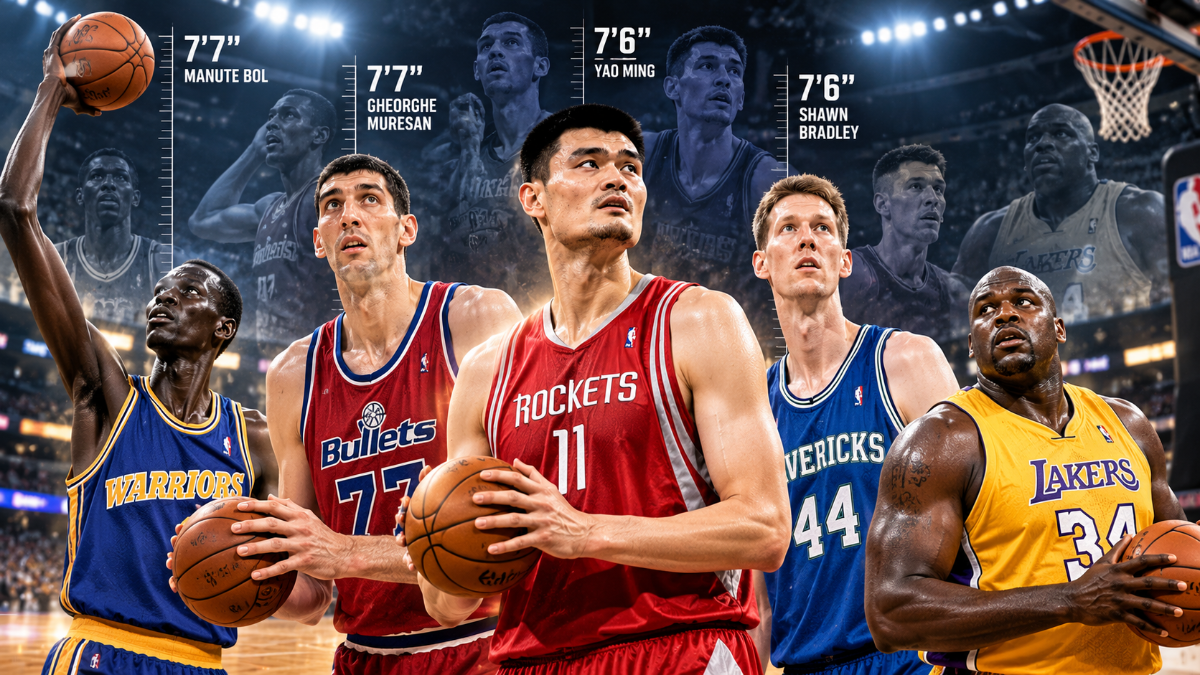
The Tallest Players in NBA History
| Rank | Player | Height | Career Span |
|---|---|---|---|
| 1 (tie) | Manute Bol | 7’7″ | 1985-1995 |
| 1 (tie) | Gheorghe Muresan | 7’7″ | 1993-2000 |
| 3 | Yao Ming | 7’6″ | 2002-2011 |
| 4 (tie) | Shawn Bradley | 7’6″ | 1993-2005 |
| 4 (tie) | Slavko Vranes | 7’6″ | 2003-04 (brief stint) |
| 6 | Pavel Podkolzin | 7’5″ | 2004-06 |
| 7 (tie) | Yasutaka Okayama | 7’5″ | 1981-82 (brief stint) |
Manute Bol and Gheorghe Muresan share the distinction of being the tallest players in NBA history at 7-foot-7, though their careers and impact on the game could hardly have looked more different from one another.
Manute Bol: The Ultimate Shot-Blocking Outlier
Bol’s combination of extreme height and an exceptional wingspan made him one of the most statistically unique defensive players the league has ever seen, despite a career limited by a slight frame that never allowed him to add significant strength. He led the league in blocks per game twice, and his single-season blocks-per-game averages remain among the highest ever recorded, reflecting a defensive impact built almost entirely around length and timing rather than physical bulk. Offensively, Bol was limited, but he developed a surprising three-point shot later in his career, an unusual skill for a player of his era and physical profile, making him a genuine statistical novelty even among the sport’s tallest players.
Gheorghe Muresan: From Physical Curiosity to Sixth Man of the Year
Muresan’s career took a notably different path than Bol’s, developing into a genuinely productive offensive center for the Washington Bullets during the mid-1990s. He won the NBA’s Sixth Man of the Year award in 1996, becoming statistically productive enough to earn significant playing time despite the mobility limitations that typically accompany a frame of his extreme size. His career was ultimately shortened by chronic foot and knee problems related to the physical stress his height placed on his lower body, a common theme among several of the league’s tallest players throughout history.
Yao Ming: The Most Successful Player at This Height
Among the NBA’s tallest players, Yao Ming stands out as by far the most individually accomplished, combining his 7-foot-6 frame with genuine offensive skill, footwork, and touch that allowed him to become an eight-time All-Star before injuries shortened his career. Yao’s arrival from China represented one of the most significant international basketball stories of his era, helping expand the NBA’s global popularity significantly while establishing himself as one of the league’s most skilled and effective centers, a rare combination of extreme size and genuine offensive polish that few of the league’s other tallest players ever developed to the same degree.
Shawn Bradley: A Cautionary Tale in Translating Height Into Production
Shawn Bradley’s career illustrates how difficult it can be to translate extreme height into consistent on-court production. Despite his 7-foot-6 frame, Bradley struggled throughout his career with a lack of strength and physicality, becoming a frequent target for posterizing dunks that became a recurring highlight-reel storyline throughout the 1990s and early 2000s. His career nonetheless included stretches of solid shot-blocking production, and his statistical case serves as a useful reminder that height alone, without complementary strength, coordination, and basketball skill, doesn’t automatically translate into NBA success.
Biggest NBA Players by Listed Weight
| Rank | Player | Listed Weight | Height |
|---|---|---|---|
| 1 | Oliver Miller | 300+ lbs (peak) | 6’9″ |
| 2 | Shaquille O’Neal | 325 lbs | 7’1″ |
| 3 | Chuck Nevitt | 290 lbs | 7’5″ |
| 4 | Priest Lauderdale | 305 lbs | 7’4″ |
| 5 | Robert Traylor | 300+ lbs | 6’8″ |
Weight-based rankings tell a genuinely different story than pure height, since a player’s listed weight reflects team-specific measurement practices that have historically varied and evolved throughout NBA history, particularly for players whose weight fluctuated significantly across their own careers due to conditioning challenges or injury recovery.
Shaquille O’Neal: Size and Athleticism Combined
O’Neal’s combination of extreme size and genuine athleticism separates him from most other names on the biggest-players list, since he paired his listed 325-pound frame with explosive leaping ability and surprising quickness for a player his size, particularly earlier in his career with the Orlando Magic and Los Angeles Lakers. This combination made him nearly impossible to defend in the post using conventional single coverage, forcing opposing teams to build entire defensive game plans specifically around limiting his post touches, a level of individual gravitational pull that few players in NBA history, regardless of size, have ever replicated.
Why So Many of the Tallest Players Faced Injury Struggles
A recurring pattern among the league’s tallest players involves chronic injury issues, particularly affecting the feet, ankles, and knees. The sheer physical stress that extreme height places on a player’s lower body joints, combined with the biomechanical challenges of supporting that much frame through the repeated jumping and lateral movement NBA basketball requires, has shortened or limited the effectiveness of numerous careers among this group. Yao Ming’s career, despite his genuine skill and productivity, was ultimately cut short by recurring foot and ankle stress fractures. Muresan’s knee and foot problems similarly limited his career length. This pattern suggests that extreme height, while providing obvious positional advantages, also carries a physical cost that shorter players simply don’t face to the same degree.
The Modern Giant: A Different Kind of Big Man
Victor Wembanyama’s early career has introduced a genuinely new archetype among the NBA’s tallest players — a player combining a 7-foot-4 frame with perimeter shooting range, ball-handling ability, and shot-blocking timing that has no direct historical precedent among the sport’s biggest men. Unlike most of the extremely tall players discussed above, whose height often came with corresponding mobility limitations, Wembanyama’s game incorporates genuine perimeter skill alongside his physical dimensions, suggesting the specific combination of size and skill that’s become increasingly valued throughout the modern league may be reshaping what teams and scouts expect from the tallest available talent entering the draft each year.
How Scouting Has Evolved for Extremely Tall Prospects
The league’s approach to evaluating extremely tall draft prospects has shifted significantly over the decades covered by this list. Earlier eras frequently drafted players based primarily on height alone, betting that sheer size would eventually translate into professional-level production regardless of other basketball skills, a philosophy that produced several of the more statistically limited careers discussed above, including Shawn Bradley and various other tall players who never fully developed complementary skills. Modern scouting increasingly prioritizes mobility, coordination, and skill development potential alongside pure height, reflecting lessons learned from decades of draft outcomes among the league’s tallest prospects, and helping explain why a player like Wembanyama, who combines his height with genuine perimeter skill, was viewed so differently by scouts than a similarly sized prospect might have been evaluated in earlier decades.
International Players and the Global Search for Size
Many of the league’s tallest players have come from international basketball pipelines, including Yao Ming from China, Gheorghe Muresan from Romania, and Manute Bol from Sudan. This pattern reflects how thoroughly NBA teams have historically scouted internationally specifically in pursuit of players with the kind of extreme height that remains statistically rare within any single country’s domestic basketball development system. As global scouting networks have continued expanding and improving over the past several decades, NBA front offices have become increasingly effective at identifying and developing extremely tall international prospects earlier in their basketball development, a trend that has directly contributed to the increasing skill level seen among more recent additions to this list compared to some of the more physically limited tall players from earlier NBA eras.
Comparing Playing Styles Across the Height Spectrum
Looking across this entire list reveals just how differently these players actually approached the game despite sharing similarly extreme physical dimensions. Bol and Muresan represented largely defensive-and-limited-offense profiles typical of earlier eras’ approach to extreme size. Yao Ming represented a more offensively skilled, international-influenced approach that emerged as scouting and player development improved. O’Neal represented pure physical dominance translated into overwhelming offensive production. And Wembanyama represents an emerging modern archetype blending traditional size advantages with perimeter skills that would have been considered almost unthinkable for a player his height just two decades earlier. This progression illustrates that “tallest” and “biggest” have never described a single, uniform type of player, but rather a physical starting point from which genuinely different basketball careers and identities have been built across the sport’s history.
The Draft Value Question Surrounding Extreme Height
NBA front offices have long grappled with how much draft value to place on extreme height alone, given how inconsistently it has translated into professional success across the players discussed in this piece. Some franchises have historically been willing to spend a lottery pick on a 7-foot-5 or taller prospect purely on the bet that height itself represents a positional advantage difficult to teach or acquire any other way, even when that specific prospect’s skill level lagged well behind other available options. Other franchises have taken a more skeptical approach, preferring to draft based on demonstrated skill and production even at the cost of passing on a taller, more physically imposing prospect. Neither approach has proven universally correct, since this list includes both draft hits like Yao Ming, taken with real conviction about his skill translating to the NBA level, and clear disappointments like several other extremely tall prospects whose height alone couldn’t overcome significant skill or mobility limitations once they reached professional competition.
How Broadcast and Media Coverage Shaped Public Perception
Media coverage of the league’s tallest players has historically emphasized their physical novelty as much as their on-court performance, a pattern that shaped how the broader public perceived several careers on this list. Manute Bol and Gheorghe Muresan both received significant media attention specifically framed around their unusual height, sometimes overshadowing genuine basketball accomplishments, like Muresan’s Sixth Man of the Year award, that deserved standalone recognition separate from simple physical curiosity. This dynamic has shifted somewhat in more recent coverage of players like Victor Wembanyama, where media attention increasingly balances genuine skill analysis alongside acknowledgment of his unusual physical dimensions, reflecting a broader evolution in how sports media approaches covering statistically unusual physical outliers compared to earlier decades.
Final Thoughts
The tallest and biggest players in NBA history represent a genuinely diverse range of basketball careers built from similarly extreme physical starting points. Manute Bol’s shot-blocking specialization, Yao Ming’s offensive skill and international significance, Shaquille O’Neal’s overwhelming combination of size and athleticism, and Victor Wembanyama’s emerging modern blend of size and perimeter skill all demonstrate that height alone has never determined what kind of player eventually develops from it. As scouting, player development, and sports science continue advancing, the profile of what a dominant, extremely tall NBA player looks like will likely keep evolving well beyond what any of the players on this list could have demonstrated during their own respective eras.
Frequently Asked Questions
Who is the tallest player in NBA history? Manute Bol and Gheorghe Muresan are tied for the tallest, both listed at 7-foot-7 during their respective NBA careers.
Who is considered the most successful player among the league’s tallest men? Yao Ming is generally regarded as the most accomplished, combining his 7-foot-6 frame with genuine offensive skill to become an eight-time All-Star before injuries shortened his career.
Why have so many extremely tall NBA players struggled with injuries? The physical stress that extreme height places on the feet, ankles, and knees, combined with the biomechanical demands of jumping and lateral movement in professional basketball, has historically shortened or limited the effectiveness of many careers among the league’s tallest players.
NBA Preseason 101: Rules, Roster Limits and Why the Games Don’t Count