Oldest Quarterbacks to Start a Super Bowl: Tom Brady’s Record 43 Years, 189 Days
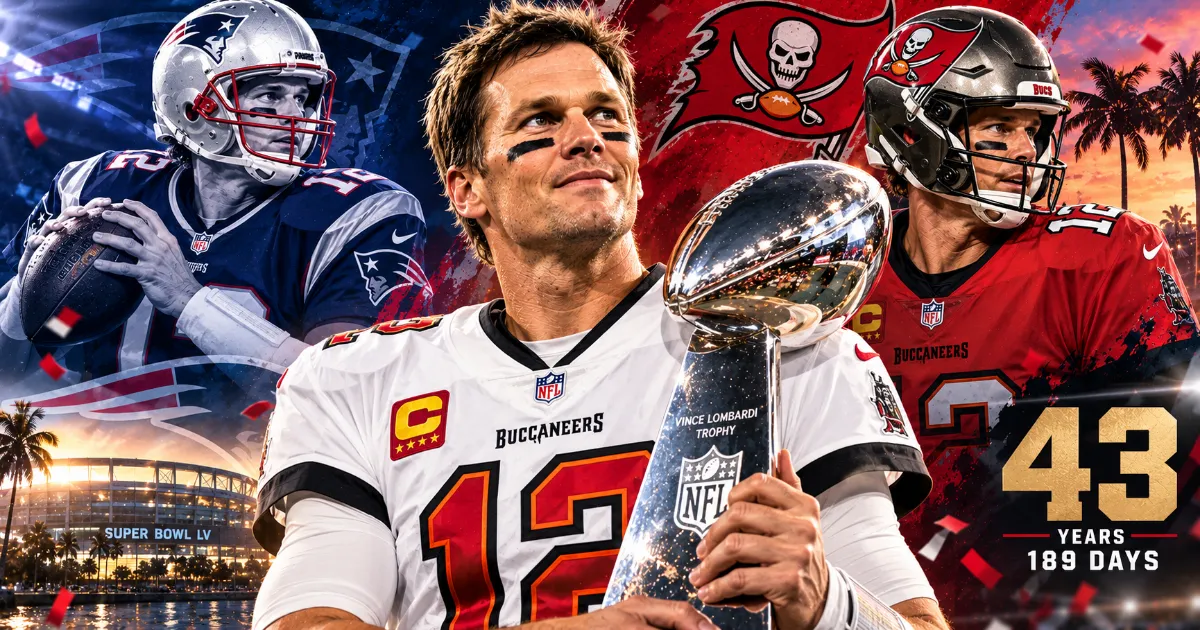
If the record for youngest quarterback to start a Super Bowl has proven remarkably durable, the record for oldest has been almost the opposite story — a mark that’s been rewritten repeatedly over the past decade, almost entirely by one player. Tom Brady started, and won, Super Bowl LV with the Tampa Bay Buccaneers at 43 years and 189 days old, the oldest any quarterback has ever taken the field to start football’s championship game. It’s a record Brady set by breaking his own previous record, which he’d also set by breaking his own record before that.
Most Interceptions in NFL History: Paul Krause’s Untouched Record
Future of Mobility: 7 Technologies That Could Change How We Travel
The Record: Tom Brady, 43 Years, 189 Days
Brady’s age record was confirmed by Guinness World Records following Super Bowl LV in February 2021, when he led Tampa Bay to a 31-9 win over the Kansas City Chiefs, throwing three touchdown passes without an interception. What makes the record particularly remarkable isn’t just Brady’s age itself, but the fact that he was still performing at an elite, championship-winning level rather than simply appearing in the game as a diminished former star. Brady’s performance that day — 201 passing yards on better than 70% completion, spread across a controlled, efficient game plan — looked more like the work of a quarterback in his prime than one closing in on his mid-40s.
How Brady Broke His Own Record Multiple Times
What separates this record from almost any other individual mark in football is that a single player has held it, broken it, held it again, and broken it again across several consecutive Super Bowl appearances. Brady first became the oldest starting quarterback in Super Bowl history at age 39 during Super Bowl LI in February 2017, a game the Patriots won in dramatic overtime fashion after trailing the Atlanta Falcons 28-3. He extended his own mark the following year at Super Bowl LII, held it again at 41 years old during Super Bowl LIII in February 2019 — a win over the Los Angeles Rams that also made him the oldest quarterback ever to win the game at that time — and then reset it one final time at 43 in Super Bowl LV. Across those years, “oldest quarterback to start a Super Bowl” and “current Tom Brady age” became functionally the same statistic, since no other quarterback in the sport’s history has even approached that range at the position’s most demanding stage.
The Record Before Brady: A Steadier, More Gradual Climb
Before Brady began his run of self-broken records, the mark had climbed much more gradually across NFL history, reflecting how rare it traditionally was for a quarterback to remain a starting-caliber player deep into his late 30s, let alone reach a championship game at that age.
John Elway held the pre-Brady benchmark, starting and winning Super Bowl XXXIII for the Denver Broncos at 38 years old in January 1999 — a fitting capstone to a career that also included an earlier Super Bowl win one year prior, at age 37. Elway retired immediately after that second title, going out as the oldest quarterback ever to win the game up to that point, a record that stood until Peyton Manning surpassed it nearly two decades later.
Peyton Manning broke Elway’s record in February 2016, winning Super Bowl 50 with the Denver Broncos at 39 years and 320 days old, in what turned out to be the final game of his career. Manning’s performance that day leaned heavily on Denver’s dominant defense rather than his own arm — a marked contrast to Brady’s still-sharp passing performance five years later in Super Bowl LV — but the win itself was enough to make him, briefly, the oldest quarterback ever to hoist the Lombardi Trophy.
Earl Morrall, a Miami Dolphins backup thrust into a starting role, is one of the more unusual names in this history. He started and won Super Bowl VII for Miami in January 1974 at 38 years, 241 days old, part of the Dolphins’ perfect 1972 season legacy, having stepped in for an injured Bob Griese earlier that year and simply never given the job back.
Johnny Unitas, one of the sport’s pioneering great quarterbacks, started Super Bowl V for the Baltimore Colts at 37 years old in January 1971, though he was knocked out of the game by injury before it ended, with Morrall — in a strange twist of history — coming off the bench to help complete the Colts’ comeback win in that very game.
Why Brady’s Longevity Broke the Historical Pattern
For decades, quarterbacks reaching their late 30s and still starting in the league at all was considered a notable achievement, let alone reaching a Super Bowl at that age. Elway and Manning both essentially closed out their careers with their oldest Super Bowl starts, treating those late-30s appearances as a fitting final chapter rather than a sign of sustained peak performance. Brady inverted that pattern entirely: rather than a late-career capstone, his Super Bowl appearances in his 40s came in the middle of what was still a highly productive stretch of football, one that included an entirely new franchise, a Super Bowl-winning first season in Tampa Bay, and continued elite-level play that extended two full years beyond his age-43 title.
Why This Record Is Unlikely to Be Broken Soon
Matching or breaking Brady’s mark would require an active quarterback not just to remain a starting-caliber NFL player into his mid-40s — already an exceptionally rare feat — but to do so while leading a team good enough to actually reach the Super Bowl at that age. As of the 2026 season, no active quarterback is within striking distance of that combination. Aaron Rodgers, the active quarterback with the most realistic case for extending his career into his mid-40s, has not reached a Super Bowl since Brady’s own playing days overlapped with his career, and most other elite quarterbacks currently active are more than a decade younger than the threshold Brady’s record demands. Given how unusual Brady’s blend of health, performance and team context was even by his own historical standard, this particular record looks likely to stand for a considerable amount of time.
How This Record Complements the Youngest-Starter List
It’s worth noting how these two extremes — oldest and youngest quarterbacks to start a Super Bowl — tell very different stories about how championship windows open for a quarterback. Dan Marino’s record as the youngest starter, and Drake Maye’s near-miss of that mark in Super Bowl LX, both reflect situations where an organization built a championship-caliber roster around a quarterback almost immediately upon his arrival. Brady’s record at the opposite end reflects the reverse: a quarterback whose individual level of play remained so persistently high, for so unusually long, that his teams kept building championship rosters around him well into an age range where most of his peers had either retired or become backups years earlier.
The Bottom Line
Tom Brady’s record as the oldest quarterback to start — and win — a Super Bowl, set at 43 years and 189 days old in Super Bowl LV, caps off a run in which he broke his own record several times over across his final Super Bowl appearances. Elway, Manning, Morrall and Unitas each represented the standard for their own eras, but none came within several years of Brady’s final mark. Given how unusual the combination of individual longevity and sustained team success required to challenge this record actually is, it’s reasonable to expect Brady’s name to remain at the top of this particular leaderboard for a long time to come.
🔹🔹 Follow us on Facebook 🔹🔹