Most Consecutive Games With a Passing Touchdown: Drew Brees’ Record 54
Few NFL records capture a quarterback’s week-to-week consistency as clearly as a streak of consecutive games with a touchdown pass. Throwing a touchdown in one game is a routine expectation for an established starting quarterback. Doing it in every game for several consecutive seasons, however, requires sustained production, availability and the ability to find the end zone against different opponents and defensive schemes.
Drew Brees holds the NFL record with 54 consecutive regular-season games with at least one passing touchdown, a streak that ran from 2009 through 2012 during his time with the New Orleans Saints. He surpassed the previous record of 47 games set by Johnny Unitas, whose achievement had stood for more than five decades.
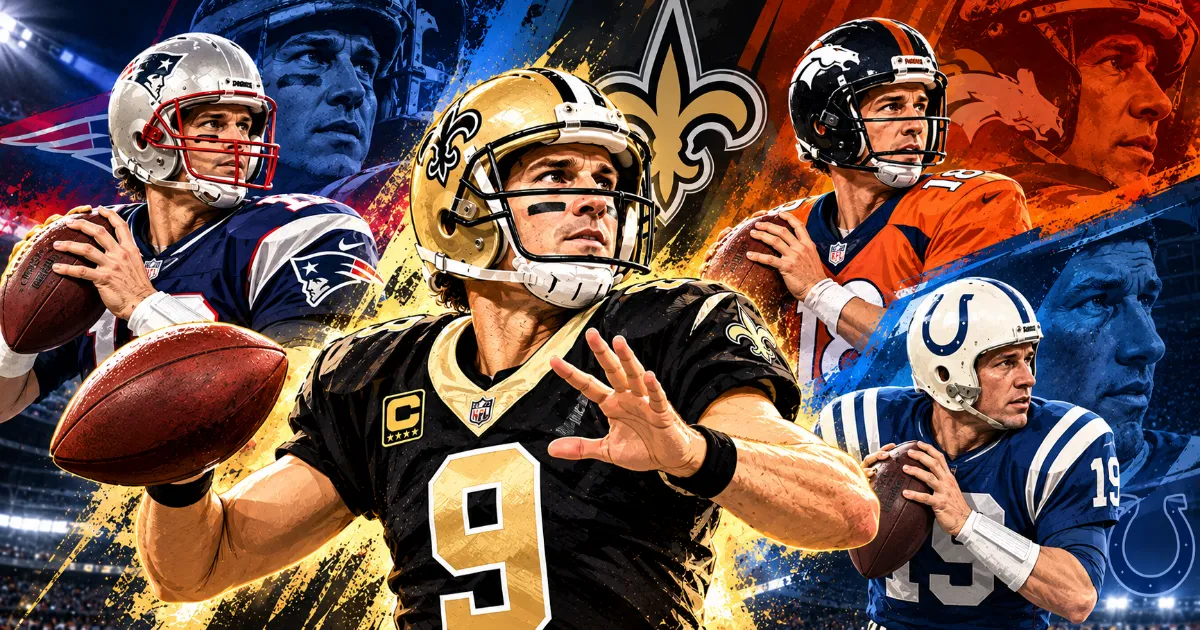
Tom Brady and Peyton Manning also produced remarkable touchdown-passing streaks during the same general era as Brees. Their performances highlight how several elite quarterbacks maintained exceptional scoring consistency during a period when NFL offenses were becoming increasingly pass-oriented.
The record is about more than the number of touchdown passes thrown. It measures how consistently a quarterback could deliver at least one passing score every week, regardless of the opponent, the game plan or the circumstances surrounding the game.
The NBA Records Most Likely to Stand Forever
Drew Brees’ Record: 54 Consecutive Games With a Passing Touchdown
Drew Brees’ historic streak began on October 18, 2009, and continued through November 25, 2012, covering parts of four NFL seasons. During this period, he played a central role in the New Orleans Saints’ offense and helped establish the franchise as one of the league’s most productive passing teams.
Brees broke Johnny Unitas’ longstanding record on October 7, 2012, when he threw a touchdown pass against the San Diego Chargers. The moment had an additional connection to his career because the Chargers were the team that originally drafted him in 2001. He played his first five NFL seasons in San Diego before joining New Orleans in 2006.
Brees’ streak eventually ended against the Atlanta Falcons on November 29, 2012. Although he threw for 341 yards, he did not record a passing touchdown and threw five interceptions in a 23–13 defeat. His streak ended, but the achievement remained intact: he had recorded at least one passing touchdown in 54 consecutive regular-season appearances.
The run also included the Saints’ Super Bowl XLIV championship season. Brees’ performance during this period demonstrated his ability to sustain touchdown production across changing opponents and game situations.
His record is particularly notable because a single game without a passing touchdown would have ended the streak. A quarterback could still win such a game through rushing touchdowns, defensive scoring or a strong running attack, but none of those outcomes would preserve a passing-touchdown streak.
Johnny Unitas: The Record That Stood for More Than 50 Years
Before Brees surpassed him, Johnny Unitas held the record with 47 consecutive games featuring at least one passing touchdown. Unitas established the streak with the Baltimore Colts between 1956 and 1960, during a very different era of professional football.
Unitas was one of the defining quarterbacks of his generation. His passing ability, leadership and influence on the development of the modern quarterback position helped establish his place in NFL history. He won three NFL championships, including the Colts’ victory in Super Bowl V, and earned three NFL Most Valuable Player awards.
His touchdown streak was particularly remarkable because NFL offenses in the 1950s operated under different conditions from those of the modern era. Teams generally had fewer games in a regular season, and passing attacks were not used with the same frequency or variety seen today.
Unitas’ record survived for 52 years before Brees finally broke it. That longevity shows how difficult it was for even the most accomplished quarterbacks to maintain a touchdown streak over such an extended period.
Brees’ achievement did not diminish Unitas’ accomplishment. Instead, it connected two generations of quarterbacks whose careers helped define different stages of NFL passing history.
Most Consecutive Games With a Passing Touchdown: All-Time Leaderboard
Several quarterbacks have recorded extended streaks of consecutive games with a passing touchdown. Brees leads the historical list, followed by Brady, Manning and Unitas.
The following leaderboard reflects the figures provided for this article. Exact streak dates and totals should be checked against an authoritative NFL statistical database before publication, particularly for streaks that may be counted differently depending on regular-season and postseason inclusion.
Rank | Quarterback | Consecutive games |
|---|---|---|
1 | Drew Brees | 54 |
2 | Tom Brady | 52 |
3 | Peyton Manning | 51 |
4 | Johnny Unitas | 47 |
5 | Drew Brees | 45 |
6 | Kirk Cousins | 39 |
7 | Tony Romo | 38 |
8 | Brett Favre | 36 |
9 | Andrew Luck | 34 |
10 | Patrick Mahomes | 31 |
Brees appears twice because he recorded another extended streak after his record-setting run ended. His second streak reportedly reached 45 consecutive games, demonstrating that his first achievement was not an isolated period of consistency.
Brady and Manning also stand out. Both built streaks exceeding 50 games, putting them among the few quarterbacks who came close to Unitas’ long-standing record before Brees established the new benchmark.
The leaderboard also includes quarterbacks from different generations. Favre and Romo played in different offensive environments from Cousins and Mahomes, making the list a useful illustration of how sustained passing production has developed across the league.
Tom Brady’s 52-Game Streak
Tom Brady recorded a streak of 52 consecutive regular-season games with at least one passing touchdown, according to the figures in the supplied leaderboard. The streak ran from 2010 through 2013 during his time with the New England Patriots.
Brady’s run came during a highly productive period in New England. The Patriots consistently relied on his ability to read defenses, make quick decisions and distribute the football to different receivers. His connection with tight end Rob Gronkowski became an important feature of the offense, while other receiving options helped create opportunities in different areas of the field.
Brady’s touchdown streak reflected his ability to maintain a reliable scoring output even when individual matchups and game plans changed. He did not need to throw multiple touchdown passes in every game to keep the streak alive. One passing touchdown was enough.
That distinction is important. A quarterback could throw for 300 yards without a touchdown pass and still end a streak, while another quarterback might finish with modest passing yardage but preserve it with a single scoring throw.
Brady’s 52-game run placed him just two games behind Brees’ record. It also reinforced his reputation for sustained production over a long career.
Peyton Manning’s 51 Consecutive Games
Peyton Manning’s streak of 51 consecutive games with a passing touchdown is another major achievement on the leaderboard.
Manning played for the Indianapolis Colts and Denver Broncos during his NFL career. He was known for his preparation, pre-snap adjustments and ability to identify defensive weaknesses before the ball was snapped.
His streak extended across his time with both franchises, reflecting his ability to maintain passing production despite a change of team and offensive environment. Manning’s command of the offense helped him create scoring opportunities through timing, anticipation and accurate distribution.
His 2013 season with Denver was especially productive. Manning threw 55 touchdown passes during the regular season, setting an NFL record at the time. The Broncos’ offense featured multiple receiving threats, including Demaryius Thomas, Eric Decker, Wes Welker and tight end Julius Thomas.
Manning’s record-setting season illustrates how a quarterback’s streak can benefit from an offense that creates frequent opportunities to score through the air. However, maintaining a streak for more than 50 games still requires consistency across many different opponents and circumstances.
Why the Early 2010s Produced Several Long Streaks
The timing of the Brees, Brady and Manning streaks is notable. All three quarterbacks produced their longest runs during an era when passing offenses were becoming increasingly prominent in the NFL.
Rule enforcement, offensive formations and route concepts helped shape the modern passing game. Teams increasingly used quick throws, short-to-intermediate routes and formations designed to create favorable matchups for receivers.
These approaches can improve a quarterback’s opportunities to complete passes and sustain drives. Reaching the end zone still requires execution, but a productive passing offense creates more chances to record a touchdown pass in each game.
The surrounding personnel also matters. Reliable receivers, effective pass protection and a coaching staff that understands how to attack defensive weaknesses can all contribute to consistent scoring production.
That context helps explain why several of the longest streaks belong to quarterbacks whose careers overlapped during the early 2010s. It does not make their achievements automatic: a streak of more than 50 games can end because of one scoreless passing performance, even after years of success.
Patrick Mahomes and the Modern Quarterback Era
Patrick Mahomes is among the most prominent quarterbacks of the current generation. His ability to make accurate throws under pressure, extend plays and produce explosive passing performances has helped him become one of the NFL’s leading offensive players.
The supplied leaderboard credits Mahomes with a streak of 31 consecutive games with a passing touchdown between 2019 and 2021. Although this is well below Brees’ record, it demonstrates how consistently Mahomes produced passing scores during that period.
Mahomes has played in an offense designed to create opportunities through both structured passing plays and improvisation. His connection with tight end Travis Kelce has been especially important, while the Chiefs have used a variety of receivers and offensive concepts to challenge opposing defenses.
However, Mahomes’ streak ended in 2021, so it should not be described as an active streak. His future career totals will depend on the number of games he plays and whether he establishes another extended run.
Breaking Brees’ record would require Mahomes or another quarterback to sustain a passing touchdown streak for more than three full seasons without a single regular-season game lacking a passing score.
The Related Record: Consecutive Games With Multiple Touchdown Passes
Recording one touchdown pass in every game is a different challenge from throwing multiple touchdown passes consistently.
A quarterback who throws two or more touchdown passes in a game has generally produced a more substantial scoring performance through the air. However, maintaining that level of production over consecutive games is much more demanding because it leaves less room for an offense to rely on rushing touchdowns or defensive scoring.
Peyton Manning’s 2013 campaign is a useful example of sustained touchdown production. He threw 55 regular-season touchdown passes that year, helping the Broncos establish one of the most productive passing offenses in NFL history.
Manning’s success was supported by an experienced receiving group and a system that created scoring opportunities throughout the season. His performance shows how a quarterback can sustain high touchdown production when the passing game functions effectively across multiple positions.
When discussing consecutive multi-touchdown records, however, it is important to distinguish between a single-season total and a consecutive-game streak. They measure different achievements and should be verified separately before publication.
Why a Touchdown Streak Can End Even After a Strong Performance
Brees’ streak ended in a game in which he still threw for 341 yards. That detail illustrates an important limitation of touchdown streaks: they measure whether a quarterback throws at least one touchdown pass, not how well he performs in every other aspect of the game.
A quarterback might complete numerous passes, accumulate significant yardage and lead several scoring drives without throwing a touchdown. The team could score through rushing plays or field goals instead.
Game plans can also change depending on the opponent. A team with a strong running game might choose to attack on the ground near the goal line, reducing the quarterback’s chances to throw a touchdown. A defense could limit passing opportunities, while turnovers might disrupt promising drives.
Injuries and weather conditions can also affect a quarterback’s performance or playing time. Even the most productive passers cannot guarantee a passing touchdown in every game.
This is why a streak should be understood as a specific statistical achievement rather than a complete measure of quarterback quality. Ending a streak does not erase the consistency demonstrated throughout the games that came before it.
Why Brees’ Record Is So Difficult to Break
To surpass Brees’ 54-game streak, a quarterback would need to throw at least one touchdown pass in 55 consecutive regular-season games. That requires more than three complete seasons of uninterrupted success, assuming a full 17-game regular season.
The difficulty lies in the number of opportunities for a streak to end. A quarterback might play well for 20 consecutive games before facing a defensive matchup that limits passing touchdowns. Another might have a game in which the offense scores several times but relies entirely on rushing touchdowns.
A long streak also requires availability. Missing games does not necessarily count as a game without a passing touchdown under standard consecutive-games-played definitions, but injuries can disrupt a quarterback’s rhythm, playing time and opportunities to extend a run.
Modern quarterbacks benefit from sophisticated offensive systems and productive passing attacks, but those advantages cannot eliminate uncertainty from individual games.
Brees’ record combines consistency, longevity and the ability to keep producing touchdown passes across a wide variety of circumstances. That is what makes it such a demanding benchmark.
The Bottom Line
Drew Brees’ 54 consecutive regular-season games with a passing touchdown remain a defining achievement in NFL statistical history. His streak broke Johnny Unitas’ 47-game record, which had stood for more than five decades, and placed Brees ahead of Tom Brady and Peyton Manning.
The leaderboard also demonstrates how different generations of quarterbacks have sustained passing production over long periods. Brady’s 52-game streak and Manning’s 51-game run came close to Brees’ mark, while Brees’ second streak of 45 games further illustrates his consistency.
Ultimately, the record is not about throwing the most touchdowns in a season or accumulating the most passing yards. It is about avoiding a single game without a passing touchdown for 54 consecutive appearances. That combination of opportunity, execution and consistency makes Brees’ streak one of the most distinctive records in professional football.
🔹🔹 Follow us on Facebook 🔹🔹