Best Quarterback Seasons in NFL History: Ranking the Record-Breaking Years
Career greatness and single-season greatness are two different conversations in football, and nowhere is that more obvious than at quarterback. A handful of individual seasons have redefined what statistical dominance at the position looks like, each one setting a new record that seemed untouchable right up until the next record-breaker came along a few years later. Here’s a look at the seasons that have defined that conversation, and why ranking them against each other is more complicated than just comparing raw numbers.
Most Successful NFL Teams of All Time: Packers Lead With 13 Titles
1984: Dan Marino Sets the Standard
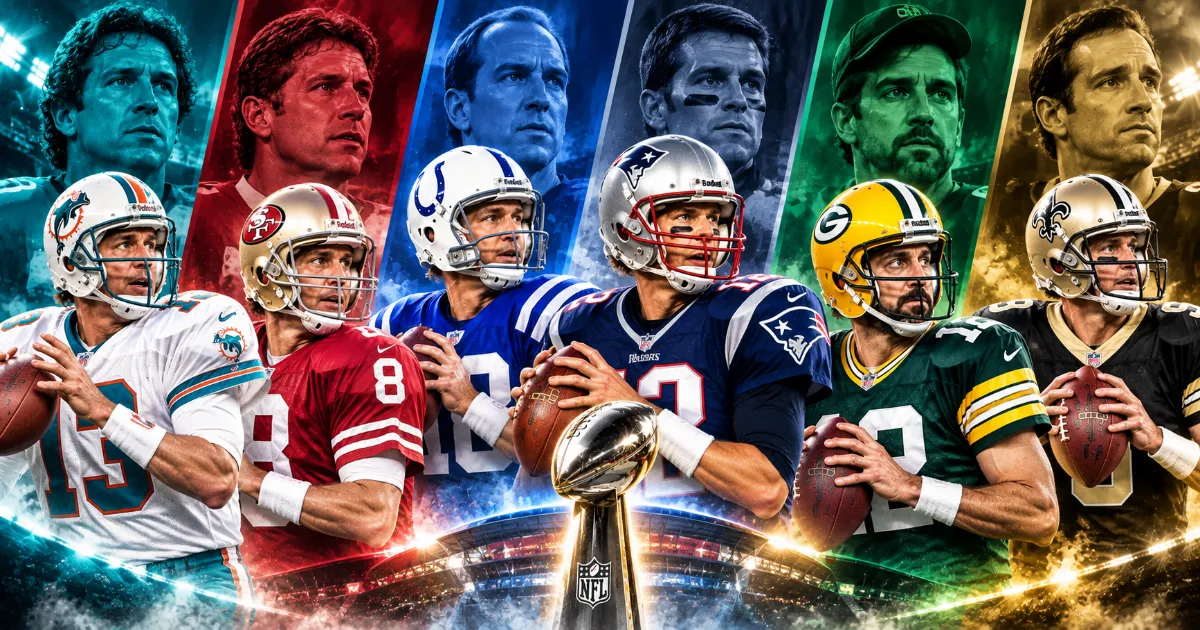
Dan Marino’s 1984 season remains one of the most important in NFL statistical history, not just for what he accomplished but for how far ahead of his era it was. In just his second NFL season, Marino threw for 5,084 yards and 48 touchdowns, leading the Miami Dolphins to a 14-2 record and an eventual Super Bowl appearance. His 5,084 passing yards remain the most in a 16-game season in NFL history, a record that has stood since before most of today’s starting quarterbacks were born. His 48 touchdown passes stood as the single-season record for 20 years, an extraordinarily long time for a major statistical mark to survive in a sport that continually reinvents its passing game. Marino accomplished all of this in an era with far less rule protection for quarterbacks and passing offenses than the modern game provides, which is part of why many analysts still consider his 1984 season the most statistically remarkable of any era, relative to the rules he played under.
1994: Steve Young’s Efficiency Masterpiece
A decade later, Steve Young authored a season that, while less flashy in raw touchdown or yardage totals, set the standard for quarterback efficiency. Young threw for 3,969 yards and 35 touchdowns while completing 70.3% of his passes, finishing with a passer rating of 112.8 — a new NFL record at the time, breaking a mark that had stood since Sammy Baugh’s 1945 season. Young led the 49ers to a 13-3 record and won NFL MVP honors, then closed out the year by setting a Super Bowl record with six touchdown passes in San Francisco’s Super Bowl XXIX win. His combination of accuracy, touchdown production and championship results makes 1994 one of the most complete single seasons any quarterback has ever produced.
2004: Peyton Manning Breaks Marino’s Touchdown Record
Twenty years after Marino set his touchdown mark, Peyton Manning finally broke it, throwing 49 touchdown passes for the Indianapolis Colts in 2004 while completing 67.6% of his passes for 4,557 yards. Manning’s 121.1 passer rating that season broke Young’s decade-old record and stood as the all-time single-season mark until 2011. He threw only 10 interceptions across the full season, an unusually low number for a quarterback attempting nearly 500 passes, and won NFL MVP honors in a near-unanimous vote. Manning’s 2004 season is frequently cited as the moment the modern, high-volume passing era truly began to take shape at the highest statistical level.
2007: Tom Brady’s Perfect-Season Peak
Tom Brady’s 2007 season pairs individual statistical dominance with the most complete team success of any season on this list. Brady broke Manning’s touchdown record by throwing 50 touchdown passes, completing 68.9% of his throws for 4,806 yards and a 117.2 passer rating, while the Patriots finished 16-0, the only perfect regular season since the league expanded to 16 games. Randy Moss caught 23 of Brady’s touchdown passes that year, itself a single-season receiving touchdown record. What separates 2007 from the other seasons on this list is that Brady’s statistical peak coincided exactly with his team’s best season, giving him arguably the strongest case for the single greatest season by the era’s standard measure: production plus results, even though New England ultimately lost Super Bowl XLII to the Giants.
2011: Aaron Rodgers Redefines Passer Rating
Aaron Rodgers’ 2011 season set the bar for pure passing efficiency that still stands today. Rodgers finished with a 122.5 passer rating, breaking Manning’s 2004 record, while throwing 45 touchdowns against just 6 interceptions and completing 68.3% of his passes for 4,643 yards. He set the NFL record for most games with a passer rating of 100 or higher (13) and most games at 110 or higher (12) in a single season, while becoming the first 4,000-yard passer in league history to throw six or fewer interceptions. Rodgers led Green Bay to a 15-1 record, though the Packers were upset in their first playoff game by the eventual Super Bowl champion New York Giants — a reminder that even the most statistically dominant regular season doesn’t guarantee postseason success.
2011: Drew Brees Redefines the Yardage Record
In the same season Rodgers set the passer rating record, Drew Brees broke Marino’s 27-year-old passing yardage record, throwing for 5,476 yards for the New Orleans Saints. Brees completed 71.2% of his passes that season, also a new NFL record at the time, while throwing 46 touchdowns. That three different major records — yardage, completion percentage and passer rating — were broken by two different quarterbacks in the very same season says something about how dramatically the passing environment had shifted by 2011 compared to even a decade earlier.
2013: Peyton Manning’s Record-Setting Return
Manning authored his second appearance on this list in 2013, his second season with the Denver Broncos, breaking both Brees’ passing yardage record and his own touchdown record from nearly a decade earlier. Manning threw for 5,477 yards and 55 touchdowns that season, both still standing as the NFL single-season records more than a decade later, while completing 68.3% of his passes for a 115.1 passer rating. Denver’s offense set the all-time record for points in a season (606) behind Manning’s performance, though the Broncos were routed by the Seattle Seahawks in Super Bowl XLVIII, a reminder that Manning’s most statistically dominant season, like Rodgers’ 2011 campaign, didn’t end in a championship.
Comparing the Record-Setting Seasons
| Season | Player | Yards | TDs | INTs | Passer Rating | Record |
|---|---|---|---|---|---|---|
| 1984 | Dan Marino | 5,084 | 48 | 17 | 108.9 | 14-2 |
| 1994 | Steve Young | 3,969 | 35 | 10 | 112.8 | 13-3 |
| 2004 | Peyton Manning | 4,557 | 49 | 10 | 121.1 | 12-4 |
| 2007 | Tom Brady | 4,806 | 50 | 8 | 117.2 | 16-0 |
| 2011 | Aaron Rodgers | 4,643 | 45 | 6 | 122.5 | 15-1 |
| 2011 | Drew Brees | 5,476 | 46 | 14 | 110.6 | 13-3 |
| 2013 | Peyton Manning | 5,477 | 55 | 10 | 115.1 | 13-3 |
Why Ranking These Seasons Is Genuinely Difficult
Comparing these seasons directly runs into the same era-adjustment problem that complicates most cross-generational football debates. Marino’s 1984 numbers were produced against far less favorable rules for passers than Brees or Manning enjoyed in 2011 and 2013, which is part of why some analysts argue his season, adjusted for era, remains the most impressive statistical achievement on this list despite having the lowest passer rating of the group. Brady’s 2007 season pairs individual dominance with a perfect team record, a combination none of the other seasons matched, while Rodgers’ 2011 touchdown-to-interception ratio remains the most efficient version of quarterback play the position has produced relative to volume. There’s no clean way to declare one season definitively “the best” — each represents the ceiling of a slightly different skill, in a slightly different passing environment, with a slightly different level of team success attached to it.
The Bottom Line
From Marino’s record-shattering 1984 campaign through Manning’s 55-touchdown 2013 season, these seven seasons represent the clearest individual peaks the quarterback position has ever produced. Whether Brady’s perfect 2007 record, Rodgers’ unmatched efficiency, or Manning and Marino’s raw statistical dominance deserves the top spot ultimately depends on how much weight you put on team success versus individual production versus the era a quarterback played in — which is exactly why this debate has never fully settled, even decades after some of these seasons were played.
Berlin Marathon 2026: Tigst Assefa Wins After Late Injury Ends World Record Bid